All published articles of this journal are available on ScienceDirect.

Rheological and Flowability Characteristics of PET Fibre-reinforced Self-compacting Mortar: Effects of Fibre Geometry and Dosage
 iD
Zine El abidine Laidani3
iD
Chafika Settari1
iD
Mohamed Sahraoui3
iD
Farid Debieb1
iD
El-Hadj Kadri4
iD
iD
Zine El abidine Laidani3
iD
Chafika Settari1
iD
Mohamed Sahraoui3
iD
Farid Debieb1
iD
El-Hadj Kadri4
iD
Authors Info & Affiliations
Abstract
Introduction
The rheological behaviour of Self-Compacting Mortar (SCM) is very sensitive to the addition of various additives. This paper examines the impact of recycled Polyethylene Terephthalate (PET) fibres (obtained from plastic brooms) on the fresh and rheological properties of Self-Compacting Mortar (SCM).
Methods
The fibre SCM mix was prepared with four different volume fractions (0.5% to 2.0%) of wavy and linear PET fibres, both having the same length of 20 ± 2 mm. The workability was assessed using the slump-flow and V-funnel tests (LPF), and rheological properties were determined using an Anton Paar rotational rheometer.
Results
Flowability decreased as the fibre volume increased, with a maximum decrease of around 8% at 2% fibre volume. An increase in the V-funnel flow time of up to 1.5 seconds was observed, corresponding to an increased resistance to flow between the minimum and maximum fibre content. The rheometer results showed that all mortars followed the Bingham model. The fibres showed little influence on plastic viscosity and yield stress at low fibre dosages, but at high dosages (1.5% and above) the parameters were significantly increased. The wavy fibre showed lower viscosity and improved adaptability to the granular structure of the mortar than the linear fibre.
Discussion
According to rheometer data, all mixtures complied with the Bingham model; low dosages showed that fibres had no effect on plastic viscosity or yield stress. However, beyond 1.5%, there were noticeable increases, and wavy fibres were shown to be less viscous and better able to adapt to the granular structure than linear fibres.
Conclusion
In conclusion, the use of PET Fibre-reinforced Self-Compacting Mortar (PETF-SCM) exhibits satisfactory fresh workability, rheological properties, and good sustainability, making it a potential candidate for eco-efficient concrete.
1. INTRODUCTION
The building sector is increasingly challenged to reconcile development needs with environmental sustainability, notably in the area of plastic waste management [1]. Over the last four decades, worldwide plastic waste generation has experienced a dramatic increase, exceeding a sevenfold rise to an annual volume of 360 million metric tons [1]. Polyethylene Terephthalate (PET) is one of the most prevalent plastics used in consumer products, and its environmental recalcitrance presents a substantial waste management challenge [2]. The integration of plastic waste from the packaging sector into architectural applications offers a tangible solution to plastic pollution mitigation while supporting sustainable construction practice [3]. At the same time, the development of innovative building materials like Self-Compacting Concrete (SCC) and Self-Compacting Mortar (SCM) has revolutionised modern building through improving placement efficiency, lowering labour costs, and enhancing surface durability [4]. With the aim of increasing the durability and mechanical performance of cement-based composites, fibre reinforcement is essential.
Fibre additions are the most effective way to improve the mechanical properties of different types of concrete, including toughness, fatigue resistance, impact resistance, and flexural strength [5], and enhance its resistance to high-temperature conditions during fire events [6]; despite a higher melting point, fibre-reinforced concrete exhibits equivalent fire resistance [6] and also improves post-cracking behaviour [7-9].
Steel fibres have been examined and used extensively [10], but synthetic fibres are becoming more popular due to their potential cost-effectiveness and resistance to corrosion. One possible method for creating more sustainable, fibre-reinforced composites is recycling post-consumer PET into macro-fibres, which turns a waste issue into a valuable resource [11-15]
However, adding fibres to self-compacting systems introduces a fundamental complexity. Yield stress and plastic viscosity of fresh SCC/SCM are important parameters for its performance because they guarantee flow under gravity, flow through closely spaced steel bars, and flow without bleeding or segregation [16, 17]. Fibres have the ability to disrupt this delicate equilibrium. They interfere with particle mobility, increase inter-particle friction, and can form flow-resisting networks, potentially resulting in decreased workability, increased viscosity, and even blockage [8, 18, 19]. The level of disruption is not regular; it is significantly affected by crucial fibre parameters such as type, volume fraction, geometry, length (l), diameter (d), aspect ratio (l/d), and surface roughness [8, 20]. Given the implications of the promising reported results, Ali et al. (2025) conducted a comprehensive and critical review evaluating the effectiveness of incorporating recycled PET into concrete [21].
The rheological effects of different fibres in self-compacting systems, such as steel [8, 9, 22-25], polypropylene and glass, have been extensively studied [26-29]. The Bingham, modified Bingham and Herschel-Bulkley models are commonly used to characterise the rheological behaviour of fibre-reinforced cementitious materials, with yield stress and plastic viscosity serving as essential factors [30, 31]. Additionally, research has indicated that fibre shape is important. For example, at the same dosage, hooked-end or wavy fibres can increase flow resistance more than linear fibres, but they may also offer better mechanical anchoring [8].
While prior research has investigated the utilisation of recycled PET fibres in concrete [12, 32-34], there is still a significant knowledge gap regarding the synergistic influence of PET fibre content and geometry (shape). Regarding both the SCM’s fresh and rheological behaviours. In addition, most studies focus on a single form or do not conduct a full rheological analysis utilising scientific rheometry, instead relying on empirical experiments. This approach does not representatively ensure thorough viscosity measurements, yield stress estimations, and thixotropic behaviour analysis, which may limit the ability to provide deeper knowledge of flow mechanisms.
Therefore, this study seeks to systematically explore the influence of both volume fraction (0.5%, 1.0%, 1.5%, and 2.0%) and geometry (linear vs. wavy) of recycled PET fibres on the rheology of SCM. The study models the flow behaviour using a combination of scientific rheometric analysis with a rotational rheometer and empirical workability tests (V-funnel, slump flow). The results will offer crucial insights for maximising the usage of recycled PET fibres in self-compacting systems while reaching a balance between the goals of enhanced environmental sustainability and maintained fresh-state performance.
2. EXPERIMENTAL PLAN
2.1. Materials
The Portland cement used was a local commercial product, CEM II/B 42.5N, supplied by Lafarge company of Msila (Algeria), for all mortar mixtures, with a 385 m2/kg of specific area, and 3150 kg/m3 of density, and an average compressive strength at 28 days of 42.5 MPa.
The used aggregate was a blend of 40.17% Fine Aggregate (FA) and 59.83% Coarse Aggregate (CA), respectively. This blend was used to obtain sand with a specific gravity of 2.55, a finesse modulus of 2.80 and 1.52% water absorption. The fluidity of the mortar mixtures was ensured by adding MEDAFLOW 145, a superplasticiser containing polycarboxylate ethers with a specific gravity of 1.065 kg/m3. The recycled PET fibres employed in this investigation were sourced from plastic sweeper waste. Two 20 ± 2 mm Linear (LPF) and Wavy (WPF) geometries were added to the SCM mixtures at four different volume fractions: 0.5%, 1.0%, 1.5%, and 2.0%. The fibres' specific gravity was 0.70 g/cm3, and their average diameter was 0.40 ± 0.02 mm. Figure 1 illustrates their morphology, while Table 1 lists their mechanical and physical characteristics, including tensile performance.
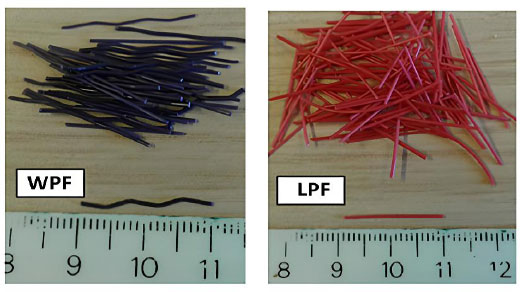
Recycled PET fibres.
| Fibre |
Thickness (mm)
Mean ± SD |
Max- Stress
(N/mm2) Mean ± SD |
Breaking Stress
(N/mm2) Mean ± SD |
Elongation
(%) Mean ± SD |
Elastic Modulus
(GPa) Mean ± SD |
Aspect Ratio
(l/d) |
Shape |
|---|---|---|---|---|---|---|---|
| WPF | 0.4±0.09 | 68.95±0.05 | 70.05±0.05 | 13.20±0.5 | 0.060±0.005 | 50 | Wavy |
| LPF | 0.4±0.09 | 65.50±0.05 | 66.54±0.05 | 12.54±0.5 | 0.057±0.005 | 50 | Linear |
2.2. PET Fibres
In this study, the recycled PET fibres were sourced from a plastic broom (Fig. 1). The diameter of the fibres is 0.40 ± 0.02 mm, and their specific gravity is 0.70 g/cm3. In the experimental mixes, 20 mm long fibres were used, and the variability and surface condition (smooth/rough) of the fibres were evaluated. The shape and the surface of the fibres were examined to determine their effect on the rheology of SCM.
Recycled PET fibres with a 0.40 mm diameter and 20 mm length (the same as used in the experimental mixtures) were tested in tension. Tensile properties such as strength and elongation of fibres were carried out in triplicate (n = 3 specimens per test), and results are shown as mean ± Standard Deviation (SD). They are important to predict their behaviour in SCM and are given in Table 1 using an INSTRON 5567 machine having a 20 kN capacity and a speed of loading of 50 mm/min.
The shape of the PET fibres was examined using SEM images obtained with a VEGA microscope in order to determine their possible impact on fibre–matrix interaction.
2.3. Mixing Procedures
The design process involved the formulation of nine distinct mix designs, encompassing two distinct series of SCM (LPF-SCM-V, WPF-SCM-V) and a Reference SCM (R-SCM). The absence of fibres in these designs is a notable feature. The prefixes LPF and WPF50 represent the fibre shape (linear or wavy), and Vf is the PET fibre volume fraction in percentage, ranging from 0.5 to 2%. The composition proportion of the considered mixes is given in Table 2.
As stated by Rossi et al, a mix design method for fibre-reinforced concrete was suggested, which was based on the Baron–Lesage method [35]. In order to ensure the validity of the self-compacting concrete formulation criteria, these were aligned with those established by the JSCE (Japanese Society of Civil Engineers) [36].
The sand-to-mortar ratio was maintained at a constant 45% by volume, with 0.90% by weight of superplasticiser relative to the cement content. The production process for SCM incorporating fibres is analogous to that of conventional fibre-reinforced concrete. The SCM mix is prepared in three stages. Initially, the cement is mixed with the aggregates in a dry state for a duration of 30 seconds. Subsequently, 60% of the required water is added, followed by 1 minute of mixing. The superplasticizer-containing water is then introduced and mixed for a further minute. Finally, PET Fibres (PETFs) are introduced, and the mixture is subjected to a blending process for a duration of five minutes. Subsequent to a 2-minute rest period, the mixture undergoes a final 30-second mixing step to ensure the homogeneous distribution of fibres throughout the concrete volume.
| Mixture | R-SCM | Fi-SCM-V | ||||
|---|---|---|---|---|---|---|
| W/C | 0.40 | |||||
| W (Kg/m3) | 210 | |||||
| C (Kg/m3) | 524 | |||||
| FA (Kg/m3) | 803 | |||||
| CA(Kg/m3) | 800 | |||||
| MEDAFLOW 145 (Kg/m3) | 4.72 | |||||
| Fibres | (%) | 0% | 0.5 | 1 | 1.5 | 2 |
| LPF/ WPF | (Kg/m3) | 3.70 | 7.40 | 11.10 | 14.80 | |
2.4. Statistical Analysis
All experimental values were the average of three determinations (n = 3 samples for one formulation in one test), and Standard Deviation (SD) was reported throughout this manuscript. To evaluate the precision of measurement for each group, the Coefficient of Variation (CV) = SD/mean × 100% was calculated for each property; all CVs were less than 5.3%, indicating that a good precision of measurements was obtained for all formulations.
To test the significance of differences in the means between formulations for each measured property, a one-way Analysis of variance (ANOVA) was performed (k = 9 groups; N = 27 total observations for each property; df_between = 8, df_within = 18). All ANOVA tests were evaluated at a level of significance of α = 0.05. Pairwise multiple comparisons were performed using the Tukey Honestly Significant Difference (HSD).
The magnitude of practical effect for each statistically significant effect was calculated using eta-squared (η2 = SS between / SS total). According to Cohen’s (1988) guidelines, effect sizes were interpreted as follows: η2 < 0.01 (negligible), 0.01–0.06 (small), 0.06–0.14 (medium), and ≥ 0.14 (large). 95% Confidence Intervals (CI) of the mean for groups were estimated as x̄±t(α/2, n−1)·(s/√n).
2.5. Fresh State Characterization of SCM
Spread and V-funnel flow time are performed on the nine fibre-SMC to define their fresh behaviour immediately following mixing. The initial evaluation involves the measurement of the spread (mini cone). The test uses a mini cone (100/70 mm diameter, 50 mm height). After placing the cone on a plane surface and filling it with paste, it was lifted, and the final diameter was obtained by averaging two perpendicular measurements.
The second test is V-funnel flow time, which involves the measurement time taken for 1100 ml of paste to flow through a 30x30 mm V-funnel nozzle. The flow time is calculated from the nozzle opening to the first light seen vertically downwards [36]; the measures and values should conform to the EFNARC specification [37].
2.6. Rheological Parameters
The rheological parameters were measured using an Anton Paar rheometer. The rheometer under consideration is a concentric cylinder type, with the lower cylinder rotating at a radius of 15 mm and a height of 40 mm, as shown in Fig. (2). The external cylinder has a diameter of 74 mm and a height of 85 mm.
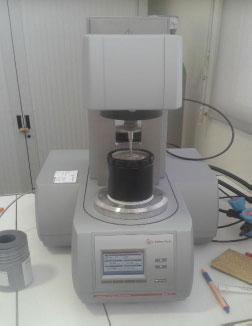
Anton paar rheometer.
It is equipped with 24 vertical rays on the interior generating surface. It is evident that each ray constitutes a right-angled section of a square with a side length of 1 mm.
The Bingham model has been shown to provide sufficient descriptive accuracy for mortars and concrete in a number of cases [18, 38-41]. In this study, the mortar under investigation is regarded as a fluid, and thus fluid rheology methods are employed to describe its flow. The two fundamental rheological parameters are the yield stress and the plastic viscosity, as defined in Eq. (1):
 ...(1)
The shear stress (τ) applied to the material is represented by τ0 (the yield stress), µ (the plastic viscosity), and  (the shear rate). Fresh mortars are tested in cylindrical samples at different rotation rates, and the torque exerted to maintain rotation is measured.
In general, flow behaviour is evaluated by the measure of shear stress over a cycle of increasing and decreasing shear rates. A rotational speed profile was applied to record the torque, where the speed ramped up to 120 rpm within 2 minutes to ensure the complete breakdown of the mixture’s internal structure (Fig. 3) [18]. The rotational speed was then held at 120 rpm for 1 minute before being gradually reduced to 2 rpm. After maintaining this low speed for 10 seconds, the speed was again increased to the maximum value over a duration of 2.5 minutes, simulating the repeated motion of the mixture during concreting, which is particularly relevant for LPF-SCM and WPF-SCM systems.
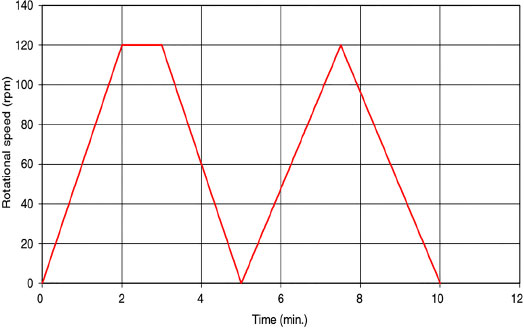
Rotation speed monitored over the first 10 minutes [18].
3. RESULTS
3.1. Slump Flow Diameter
Figure 4 displays the results of spread diameters for all mixtures, including the control mixture and those reinforced with Linear (LPF) and Wavy (WPF) PET fibres. All measured diameters were within the accepted range of 260-290 mm specified by EFNARC guidelines [37], demonstrating the self-compactability of all designed mixtures. Concrete mixes with both Linear (LPF) and Wavy (WPF) PET fibres, each with a length of 2 cm, have been shown in fresh tests to meet the criteria for self-compactability [42].
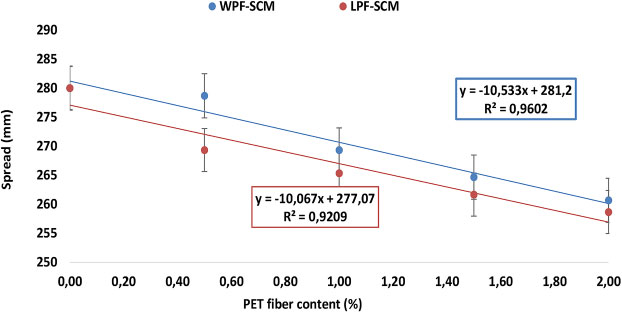
Effect of fibre content on the flow ability of PF-SCM.
An evident inverse correlation was noted between the PET fibre content and the slump flow diameter. The flowability consistently reduced when the fibre dosage increased from 0.5% to 2.0% [43]. In comparing the two fibre geometries, the Wavy Fibres (WPF) consistently demonstrated a slightly higher slump flow diameter than their Linear (LPF) counterparts at equal volume fractions, especially at 1.5% and 2.0%. This phenomenon can be explained by the wavy fibres' altered orientation mechanics and shorter effective length in the paste, which may provide less flow resistance than the rigid, straight LPF fibres [16, 44]. At the maximal fibre dosage of 2.0%, flowability decreased by approximately 8% compared to the control. This observation is consistent with earlier research on steel and synthetic fibres, which show similar decreases in slump flow as a result of the physical blockage and elevated internal friction caused by high fibre content [8, 9, 45].
According to Jamshidi (2023), polypropylene fibres at a dose of 0.5% maintain flowability that meets EFNARC requirements [46]. However, higher doses have been proven to significantly reduce fluidity [47]. The inclusion of steel fibres in SCC diminishes slump flow and prolongs flow time, signifying reduced workability [48]. However, by modifying the fibre aspect ratio, the negative effect can be reduced, and lower aspect ratios result in improved workability.
Spread flow diameter was significantly reduced with increasing fibre content (F(8,18) = 202.09, p < 0.001, η2 = 0.989). The fibre dosage explained 98.9% of the total variance in spread flow, the highest among all the rheological parameters measured. The average spread of the control mortar (P-SCM) was 280.0 ± 1.0 mm [CI: 277.5; 282.5]. The addition of WPF at Vf = 0.5% did not significantly affect the spread. The fibre content alone accounted for 85.6% of the variation in fresh-state flowability across all fibre geometries and dosage levels, as Vf had the greatest negative linear correlation with SF (r = –0.925, R2 = 0.856, p < 0.001).
3.2. V-Funnel Flow Time
The effect of PET fibres on the passing ability of mortars is given in Fig. (5), the flow time of all obtained mixtures inside the targeted domain (2 to 10 seconds) [37].
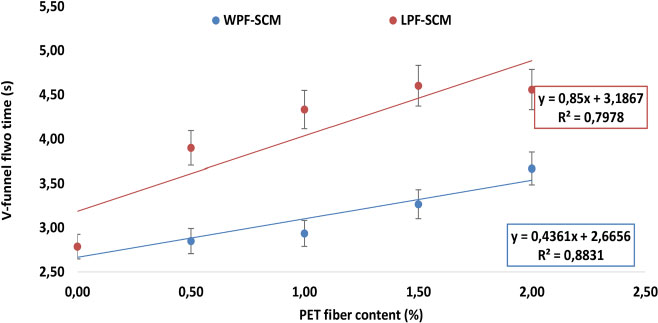
Effect of fibre content on the V-funnel flow time of PF-SCM.
Figure 5 indicates a noticeable increase in flow time with higher fibre content for both LPF and WPF mixtures. This signifies an elevation in apparent viscosity and an augmented capacity for the mixture to face resistance when traversing obstacles, a characteristic commonly linked to a higher risk of blockage in congested areas [8, 9, 18, 27, 44, 49]. The extended flow times result directly from the mechanisms governing fibre-reinforced suspensions, in which the fibres increase the interaction between solid particles, forming a more entangled network that elevates the yield stress and plastic viscosity necessary to overcome internal friction and initiate flow [8, 44, 49]. Such behaviour aligns with the slump flow test results and demonstrates that, while the mixes remain self-compacting, their ability to fill formwork declines with the fibre addition. Similar to the slump flow results, mixtures with Wavy Fibres (WPF) had significantly shorter flow times than those with Linear Fibres (LPF) at the same volume fraction. This provides further evidence for the theory that the wavy shape makes it easier to adjust to the mortar's granular skeleton, which reduces the resistance to flow through a confined area under gravity.
The reduced flowability is due to the augmented surface area and inter-particle friction caused by the fibres, which block the free movement of the mortar paste [18, 40]. Solid particle mobility within the mixture is physically restricted by the fibrous network, requiring more energy to initiate and maintain flow [27]. A higher fibre concentration can lead to the formation of fibre balls, which not only negatively affect the workability of fresh Fibre-Reinforced Concrete (FRC) but also reduce its homogeneity [50].
The incorporation of fibres resulted in a significant increase in V-funnel flow time (F(8,18) = 302.29, p < 0.001, η2 = 0.993). A significant difference between fibre types was observed. The WPF series exhibited moderate increases in V-funnel flow time from 2.787 ± 0.032 seconds (REF) to 3.669 ± 0.150 seconds at Vf = 2%, while LPF resulted in considerably higher V-funnel flow time values even at low dosages (3.900 ± 0.050 seconds at Vf = 0.5%) and increased to 4.603 ± 0.032 seconds at Vf = 1.5%. The systematic divergence indicates that the linear fibre geometry provides considerably larger resistance to flow through constrained orifices than wavy fibres at the same dosages, due to the increased spatial occupancy of straight fibres in unidirectional flow arrangements.
3.3. Rheological Properties of PF-SCM: Yield Stress and Plastic Viscosity
The empirical experiments were validated by fundamental rheological measurements utilising a controlled-stress rheometer. The Bingham fluid model (τ = τ0 + μ) demonstrated an excellent linear fit (R2 > 0.90) to the flow curves (shear stress vs. shear rate) for all mixes, confirming its suitability to characterise the PET fibre-reinforced SCM [18, 19, 27]. Figures 6 and 7 summarise the obtained Bingham parameters, including yield stress (τ0) and plastic viscosity (μ).
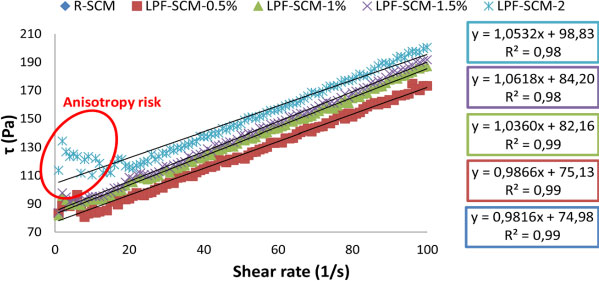
Shear stress for LPF-SCM mixtures.
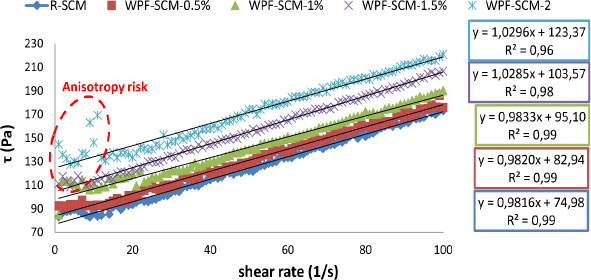
Shear stress for WPF-SCM mixtures.
According to the findings in Figs. (8 and 9), there is a critical limit for the fibre volume fraction of approximately 1.0–1.5%. At quantities lower than 1.0%, both yield stress and plastic viscosity showed minimal change against the control formulation. This implies that the fibres can be effectively added to the paste in low amounts without significantly impacting the flow and particle lubrication mechanisms [22, 27, 51]. This quick increase is typical of an interconnected fibre network, where the rheological behaviour is dominated by fibre-fibre interactions. In these cases, fibres begin to interact, building a skeleton that considerably resists flow, increasing both the stress required to initiate flow (yield stress) and the resistance to flow once it has started (plastic viscosity) [8, 9, 25, 42].
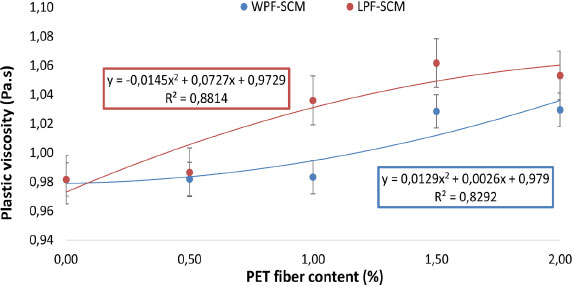
Rheological behaviour of PF-SCM mixtures: Plastic viscosity.
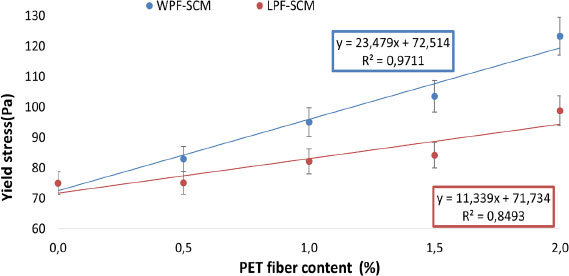
Rheological behaviour of PF-SCM mixtures: Yield stress.
The incorporation of fibre was statistically significant for the plastic viscosity of SCFRM (F(8,18) = 7.42, p < 0.001, η2 = 0.767), although it was the smallest effect size among all measured properties. The viscosity values ranged from 0.982 ± 0.023 Pa.s (P-SCM) to 1.062 ± 0.009 Pa.s (LPF-SCM-1.5%), which represents a maximum increase of 8.2%. Tukey HSD analysis showed that only LPF-SCM-1.5% and LPF-SCM-2% were significantly different from the reference and early WPF/LPF formulations (p < 0.05). The relatively moderate effect of fibre content on plastic viscosity in comparison to its dominant effect on yield stress is consistent with the Bingham model framework in which fibre incorporation preferentially increases yield stress by establishing a rigid fibre contact network, while the viscous dissipation component remains less sensitive to fibre dosage in the range of Vf investigated.
Fibre incorporation significantly increased the resistance to flow initiation in both WPF and LPF series (one-way ANOVA: F(8,18) = 135.64, p < 0.001, η2 = 0.984), showing a large and dominant effect of fibre type and dosage. In the WPF series, τ0 increased progressively from 74.98 ± 1.61 Pa (P-SCM, 95% CI: [70.99; 78.97]) to 123.37 ± 2.26 Pa at Vf = 2% (95% CI: [117.76; 128.97]), which represents a 64.5% increase compared to the reference mixture, confirming that each increase in Vf = 0.5% resulted in a statistically distinguishable increase in yield stress. The LPF series exhibited a more moderate increase in τ0 (maximum: 98.84 ± 5.16 Pa at Vf = 2%). The Pearson correlation between Vf and τ0 was r = +0.807 (R2 = 0.651, p = 0.009), confirming a strong and statistically significant monotonic relationship between fibre content and yield stress for both fibre types.
The incorporation of augmentation of fibre content resulted in an elevated yield stress observed in fibre-reinforced mortar [38]. Moreover, Fibres seemed to restrict granular motion throughout the rheological test, resulting in a decrease in the slump value and an increase in viscosity [27].
4. DISCUSSION
4.1. Microstructure and Fibre Geometry Effects
The study further demonstrates that fibre geometry has a notable effect. Mixtures containing Linear Fibres (LPF) consistently showed greater responses than those including Wavy Fibres (WPF) in terms of yield stress and plastic viscosity for a given volume fraction above 1.0%. This is explained by two mechanisms:
- Effective Aspect Ratio: By reducing the fibre's rigid length, waviness lowers the fibre's effective aspect ratio and, consequently, its capacity to interlock and create resistance [18].
- Flexibility and Adaptability: Wavy PET fibres' flexibility enables them to bend and adapt to the flow field. This adaptability allows them to be incorporated into the granular matrix with a lower impact on the paste's viscosity. In contrast, linear fibres tend to act as a solid barrier [27, 44].
On the other hand, SEM images of Wavy (WPF) and Linear (LPF) PET fibres are shown in Figs. (10 and 11), displaying clear variations in surface geometry and morphology. The wavy fibres have a non-linear geometry that improves mechanical interaction with the surrounding cementitious matrix, as well as a more irregular and textured surface [20]. Linear fibres, on the other hand, have a straight shape and a comparatively smooth surface, which reduces interfacial contact. Hence, the mortar's rheological behaviour is significantly influenced by these microstructural variations.
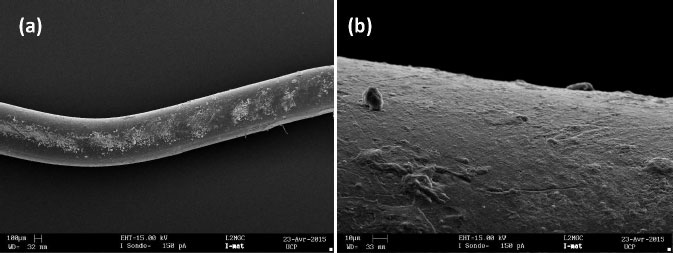
SEM analysis of wavy PET fibres.
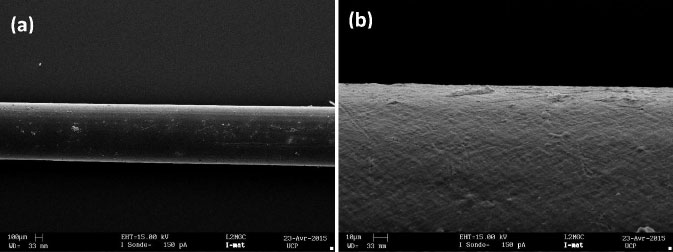
SEM analysis of linear PET fibres.
4.2. Rheological Behaviour and Critical Threshold
The impact of PET fibre volume fraction on the rheological characteristics of composite materials, particularly within the critical range of 1.0–1.5%, is significant. As demonstrated in Figs. (6 and 7), this range is particularly important because it indicates the transition from a dilute to a concentrated fibre dispersion, which, in turn, influences the matrix's flow behaviour. This phenomenon can result in the development of anisotropy during the initial stage of flow and may lead to decreased performance compared to reference samples due to fibre agglomeration and increased internal friction. These effects ultimately hinder flowability and negatively affect the material's overall behaviour [52, 44].
At this level, the fibre network can increase the material's yield stress and viscosity. This percolation threshold greatly increases the material's resistance to flow [44]. The incorporation of PF inclusions serves to modify the mixture, thereby inducing an augmentation of the granular structure and diminution of maximum compactness [12, 27, 53]. Previous research indicates that elevated fibre content is associated with increased yield stress; however, excessive levels can hinder flowability [54, 55].
Martinie et al. [44] also reported the existence of a critical fibre dosage beyond which the yield stress increases sharply. Furthermore, when the fibre content exceeds the optimum level, additional fibre incorporation appears to have little effect on increasing the viscosity of Fibre-Reinforced Concrete (FRC). This behaviour may be explained by the fact that, once a critical fibre concentration is reached, mechanical interlocking and fibre entanglement become the dominant factors controlling flow behaviour [51]. The observed phenomenon can be explained by the presence of rigid fibres (LPF), enhanced matrix stiffness, and increased material resistance to initial flow [56] compared with flexible fibres (WPF).
Furthermore, fibre-reinforced cementitious materials are generally considered highly concentrated suspensions; the interactions among fibres, as well as between fibres and other constituents such as cement, fillers, and aggregates, govern the type of internal network formed [57]. These fibre interactions involve both hydrodynamic effects and mechanical contacts, resulting in three distinct flow patterns.
The volume fraction of solid particles suspended in the liquid phase strongly influences the magnitude of hydrodynamic forces acting on particle surfaces [57]. The flow resistance occurs because particles must move past one another during deformation. Due to their elongated geometry, fibres tend to rotate and align under flow conditions; however, this movement is often influenced or restricted by adjacent particles and neighbouring fibres. This behaviour explains the rheological flow mechanism of fibre-reinforced systems [58]. Hence, the phenomenon is particularly evident with sisal fibres, where higher dosages and longer fibres significantly reduce flowability and increase yield stress and plastic viscosity [58, 59]. Fibre networks formed at excessive concentrations obstruct the movement of matrix particles, emphasising the need for an optimal fibre content to balance reinforcement and flowability [60].
Therefore, the increase in yield stress and plastic viscosity in PETF-SCM can be attributed to the enhanced fibre-matrix interaction, particularly with wavy fibres. While these fibres contribute to improved mechanical interlock and bonding, they also reduce fluidity, which can complicate the mix's workability. This underscores the importance of optimising fibre type and content to achieve the desired rheological properties and workability in practical applications [56, 61].
4.3. Correlation of Study Parameters
The correlations between rheological characteristics (yield stress and plastic viscosity) and flowability parameters (slump flow and V-funnel time) are shown in Figs. (12 and 13). Slump flow diameter and yield stress are clearly inversely correlated, suggesting that mixtures with higher yield stress are less flowable. This demonstrates that the primary factor influencing initiation of flow in self-compacting mortars is yield stress. In a similar way, a significant relationship is observed between plastic viscosity and V-funnel flow time, where longer flow periods are associated with higher viscosity. This illustrates how plastic viscosity drives flow dynamics under confined conditions by reflecting the increasing resistance to flow once deformation has begun.
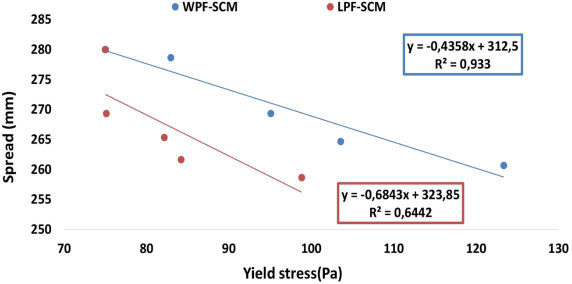
Flow- yield stress relationship.
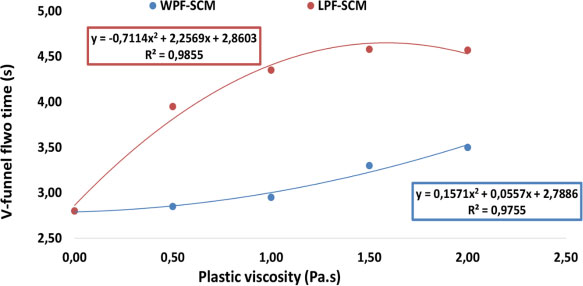
Flow time- plastic viscosity relationship.
These correlations show that rheological measurements and empirical tests are consistent, indicating that the observed variations in workability are closely related to the evolution of the mortar's internal structure. In particular, the increase in both yield stress and viscosity at increasing fibre levels favours the creation of a fibre-induced network that restricts particle mobility and increases flow resistance.
CONCLUSION
This study examines the impact of integrating recycled PET fibres on the rheological characteristics of Self-Compacting Mortar (SCM), emphasising its capacity to reduce segregation hazards. The experimental findings yield the following conclusions:
- Fibre content significantly affects the flowability of PET Fibre-reinforced Self-Compacting Mortar (PF-SCM), with mortar flowability decreasing as the fibre content increases.
- The rheometer effectively evaluates the rheological parameters of PET-SCM, particularly at a fibre volume limit of 2% with 20 mm fibres.
- The study shows that, within the fibre concentration range of 0-2.00%, PET-SCM adheres to the Bingham model, exhibiting consistent yield stress and plastic viscosity.
- Increased fibre volume correlates with higher yield stress and plastic viscosity, with a noticeable trend towards higher plastic viscosity than yield stress at higher fibre contents (1.5%).
- The use of wavy fibres leads to a more significant reduction in both plastic viscosity and yield stress compared to linear fibres, due to their relative flexibility.
- Among the various fibre configurations tested, 20 mm wavy PET fibres at a dosage of 1.50% showed the most favourable influence on the rheological behaviour of the mortar.
- The study indicates that PET-Fibre Reinforced Self-Compacting Mortar (PETF-SCM) demonstrates a promising balance between fresh workability, rheological performance, and potential sustainability in concrete applications.
While PETF-SCM shows potential for eco-efficient concrete, it is important to note that these results are based on rheological properties observed in the laboratory environment. The findings show that PETF-SCM could be an environmentally sustainable alternative for concrete with enhanced properties. Additional research is required to assess the performance and overall impact of PET fibre-reinforced concrete over time to verify its effectiveness for large-scale applications. Therefore, the findings reported here are preliminary and need to be confirmed by further studies that account for other environmental and economic factors, particularly sustainability and material efficiency.
This study covers a comprehensive parametric programme; nevertheless, several limitations must be addressed. All tests utilised a constant water/cement ratio (w/c = 0.40) and a singular cement type (CEM II/B 42.5), thereby constraining the applicability of the results to mixtures with alternative paste compositions, supplemental cementitious materials (SCMs), or matrices of greater strength. Furthermore, the impact of these fibres on the rheological and mechanical properties of Self-Compacting Concrete (SCC) merits examination.
The mechanical properties and durability performance of PET-FSCC, including resistance to chloride penetration, carbonation, and freeze-thaw cycles, were not examined, which represents a substantial gap for long-term structural applications. Third, the study fails to provide data on long-term creep, shrinkage, or fatigue performance, which are essential for structural design applications. Future research must address these constraints by using a wider array of mix design variables, conducting durability assessments, and employing advanced microstructural characterisation techniques.
AUTHORS’ CONTRIBUTIONS
The authors confirm their contributions to the paper as follows: I.I., C.S.: Study conception and design; Z.E.A., L., M.S.: Data collection; I.I., Z.E.A., L., F.D., E.H. K.: Analysis and interpretation of results; I.I., C.S.: Draft manuscript. All authors reviewed the results and approved the final version of the manuscript.
LIST OF ABBREVIATIONS
| SCM | = Self Compacting Mortar |
| SCC | = Self Compacting Concrete |
| PET | = Polyethylene terephthalate |
| PETFs | = PET Fibres |
| L | = Fibre Length |
| d | = Fibre Diameter |
| l/d | = Aspect Ratio |
| CA | = Coarse Aggregate |
| FA | = Fine Aggregate |
| LPF | = Linear PET Fibres |
| WPF | = Wavy PET Fibres |
| LPF-SCM-V | = Linear PET Fibre-reinforced SCM series |
| WPF-SCM-V | = Wavy PET Fibre-reinforced SCM series |
| R-SCM | = Reference SCM |
| JSCE | = Japanese Society of Civil Engineers |
| τ | = Shear Stress |
| µ | = Plastic Viscosity |
|
|
= Shear Rate |
| SD | = Standard Deviation |
| HSD | = Honestly Significant Difference |
AVAILABILITY OF DATA AND MATERIALS
All data generated or analysed during this study are included in this published article.
CONFLICT OF INTEREST
Dr. Farid Debieb is the Editorial Board Member of The Open Civil Engineering Journal.
ACKNOWLEDGEMENTS
The authors are grateful for the invaluable support of L2MGC Laboratory of the University of Cergy Pontoise (France).